Showing posts with label temporary housing. Show all posts

16.5.07

for sale : maison tropicale


one of the 3 existing maisons tropicales by jean prouvé will soon be auctioned by chrisitie's. an article in the nytimes describes the house's trip from congo to paris to queens (where it has been installed for viewing at a vacant lot on vernon blvd in long island city). i wish i had the 4 to 6 estimated million dollars the house is supposed to go for. not only is the house 50s and tropical and pretty to look at at the same time, but it's actually a fascinating piece of history: an artefact of dead modernism, colonialism, utopianism, protoprefabrication, pop culture and politics.

prouvé designed the house as a nomadic structure:

"while his compatriot le corbusier sculpted forms inspirad by evocative mud-packed buildings that he discovered in saharan africa, prouvé was advocating nomadic architecture for African states, modular houses that could be shipped, erected, dismantled, and shipped again like so many tinker toys. prouvé manufactured the components of his furniture and houses from a detailed understanding of fit, connections, materials, and the conveyor belt."

the times describes it as "plug and play" architecture:

"it’s cash and carry. the structure is a kit of metal parts, like an ikea piece, but bigger...the maison is also plug-and-play: there was never any plumbing, and it is wired for electricity. it ships in six containers. christie’s is compiling a short list of potential bidders with substantial properties in mustique, antigua, the hamptons — name your playground — who might like a 59-foot-by-32-foot--by-16-foot-tall folly/outdoor sculpture/guesthouse/vintage metal toy to park on the lawn, with a designer label attached."

so the house has been rebuilt in l.a. and on the roof of the pompidou. so it's become fetish and frivolous. that's our fault. and it doesn't make it any less fascinating. this particular house was "rescued" from distress in brazzavile, the capital of the republic of congo (built to compete with its belgian counterpart, léopoldville/kinshasa across from the river, now capital of the democratic republic of congo, formerly zaire...see heart of darkness). the house has been wiped of blood and bullets (its former location has been stage for a series of gruesome civil conflict, guerrilla clashes and political rivalries), but despite the revamping and the glitz surrounding it, it is still a powerful and quiet testimony of failure (of the colonial project, of the modernist project, of the funcionalist utopian project, etc):

"what went wrong? well, it turned out that, despite its clever engineering, the house was not cheap to build. how efficiently did the brightly colored, well-insulated and ventilated metal box keep its inhabitants from baking? what does it sound like inside a metal hut when it rains? who finds multiple portholes a plus and not prisonlike? indeed, there is photographic evidence that the tenants cut rectangular windows into the panels... it is also worthwhile to place the house in a broader context: after gaining its independence in 1960, congo by 1963 became a marxist republic supported by the soviet union. with the collapse of the USSR, congo drifted into a democracy that was shattered in 1997 by civil war and the return of marxist leadership. at that time, several parties in france located prouve's battered and bullet-riddled building, bought it, and arranged for it to be dismantled, packed, and shipped back to france, a final, enfeebled symbol of the end of the colonial moment. there, it was substantially reconstructed and renovated so that today's version, now on world tour, is largely cleansed of its past. somewhat akin to the "current reissues" available at such stores as design within reach, this is vintage modernism presented in a new, replicant version, untarnished and sturdy, ready to support the fantasy of a better modern life."

too bad the sanitized house isn't understood as what it is: a sign of us fucking up again.

28.3.07

california livin'


on the satellite view of google earth, a quaint little strip of greenish patchwork grows out of the black blot that is the salton sea. If you take a closer look, you’ll see a strange brown block in the middle. this is thermal, california.


back on land it musn’t seem that strange. this is, after all, the little piece of riverside twilight zone that stretches from the freshly baked freshly botoxed skin of platinum-blond old people and their peackock-feathered rental flats in palms springs to the trampled dirt of (mtv)world-famous coachella to a place called mecca and the miscarried motel paradise of the salton city, awash with dead fish.


people around here know that california livin’ isn’t quite what it’s made out to be.


and yet there’s something a bit shocking about a trailer-park slum in southern california. no sewage, no electricity, and basically living in a dum is something you would expect from a mexican bordertown shanty. but not on this side. maybe it’s shocking because it brings things uncomfortably close to home.

the l.a. times reports:

“like most of their neighbors in the sprawling, ramshackle oasis mobile home park, the aguilars have no heat, no hot water. on cold nights, the family of eight stays warm by bundling up in layers of sweaters and sleeps packed together in two tiny rooms…bathing is a luxury that requires using valuable propane to boil gallons of water. so the farmworker clan spends a lot of time dirty... jose aguilar, a wiry 9-year-old, has found a way around the bath problem. he just waits until dinner. "my mom makes frijoles," he said, "then I take a bath in that water."


“exactly how many people live in the trailer parks is unknown, but social workers estimate tens of thousands. the biggest park, desert mobile home park, or "duroville," (in spanish, duro means hard or tough) has more than 4,000 residents and can be seen off california 195 near thermal. Others are on private property and virtually invisible to passing motorists.”

these half-legal “trailer parks”, featuring special amenities such as faulty life-threatening electric wiring and views of a toxic-fumes-emission car-battery-and-paint-can-burning dump, persist because otherwise thousands of farmers would be left homeless. and that’s no good for all those green little patches you see surrounding the place, growing all sorts of goodies like fresh fruit or asparagus. so in the mean time, it seems, 15-year-old mothers and carcinogens will just have to do.

15.3.07

spanish avant-garde


i've been on the move since i was a kid, and migration is one of those subjects that always strikes a sensitive chord. lately i've been trying to follow threads on architectural / design experimentation on the border, for good or bad.

some of the most interesting cases i've come across on subtopia, "a field guide to military urbanism" (and much more, actually). a few months ago i read an old post from july 2006, called "migrant structures". the article dealt with issues of temporary migration and housing/shelter conditions. the focus of the piece was more of a 911 (nine-one-one not nine-eleven, late 80's t.v.) design emergency scenario, playing with ideas for a response to a (sort of) pressing issue. the post ultimately linked to some proposed solutions.

what struck me was the paradox behind all these good intentions. something like let's keep 'em coming, let's keep them temporary and "irregular", but at least give them a nicer place to stay (something we can show in magazines).

well, i've found this double discourse on illegal (undocumented, whatever) immigration is even more blunt in europe, and spain particularly. spaniards have become big suckers for gloss when it comes with a tinge of social concience. and on this particular issue, it seems, southern spain beat southern california:

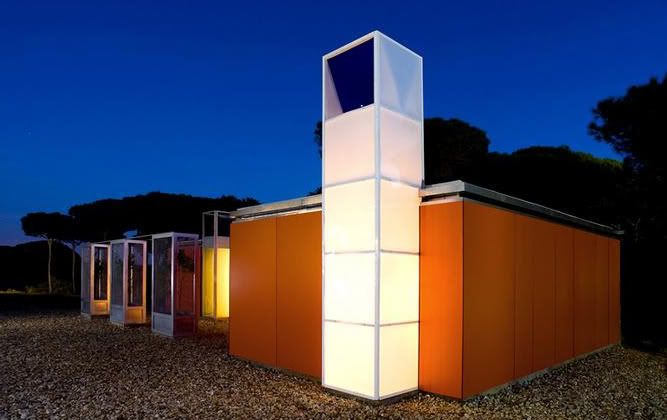
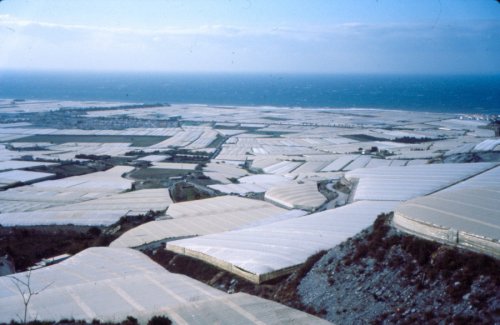
an easily-dismantaled mini-city for temporary (read: undocumented) farm workers "usually coming from romania, poland, ecuador and morroco, to pick strawberries (them too!) in huelva." the article goes on, describing the same bad living conditions the workers face (makeshift houses, shacks, tents, or even -gasp- the street...). the project proposal is by a fellow by the name of javier terrados, who won a contest held by the colegio de arquitectos of almería (yep, the place that grows freak genetically modified tomatoes on acres and acres of plastic-covered land and that keller easterling wrote about) for "decent" housing.

ejem...

today's back page of el pais is even more explicit: "if the workers come and go, why not put up and dismantle their houses at the same time?"

the thing is, do they? come and go? yes, they're only hired for some months. do they go back to morroco then, or ecuador? or just back to living in shacks until the next job comes up?